|
|
|
Forthcoming
Book:
The
Portsdown Fuel Bunker
|
|
| Created 10-07-2007 Last update
15-09-2013 |
|
|
|
|
|
|
|
Final update as of 15 September
2013 |
|
I have now abandoned all attempts to get my book
published by traditional methods. Publishers aren't interested and
I'm not interested in self publishing (the vanity route). It's
either the real deal or nothing. I began
producing an e-book but became disillusioned with this. The text is
not a problem, but the formatting of images and image pages is time consuming
and tedious, and e-book graphic rendering is not especially attractive.
Thanks to all those who have
supported and shown an interest in
this project.
Bob Hunt - 15-09-2013 |
|
|
|
The Book Timeline |
| 29-05-2012 |
E-book formatting issues mostly resolved. Formatting continues -
slowly.... |
| 11-05-2012 |
Submission rejected by 5th publisher - too specialist for their
list |
| 25-04-2012 |
Approach made to 5th publisher |
| 16-04-2012 |
I have come up against some serious problems in trying to render
low contrast photos fit to be viewed on a Kindle. Work is in
progress. |
| 14-02-2012 |
Formatting of e-book now in progress. |
| 21-01-2012 |
The book will now be published as an e-book through Amazon.
However significant new information regarding the Fuel Bunker has
come to light and publication will now take place after this has
been incorporated into the book. |
| 09-01-2012 |
Royal Navy approach fails. |
| 09-01-2012 |
Approach being made to Royal Navy for help in publication. |
| 31-12-2011 |
No reply from 2nd Publisher |
| 30-08-2011 |
Entire manuscript plus sample photos requested by and sent to 2nd
publisher (see 25-06-2011) |
| 12-08-2011 |
Seeking corporate sponsorship |
| 10-08-2011 |
Submission rejected by 4th publisher - too specialist for their
list |
| 08-08-2011 |
Synopsis sent to 4th publisher |
| 02-08-2011 |
Submission rejected by 3rd publisher - not what they are looking
for |
| 18-07-2001 |
Sent a hardcopy 3 chapter submission to 3rd publisher |
| 12-07-2011 |
Submission rejected by 1st literary agent - too specialist for
their list |
| 11-07-2011 |
57 page submission made to 1st literary agent |
| 25-06-2011 |
Approach made to 2nd publisher |
| 16-06-2011 |
Submission rejected by 1st publisher - not what they are looking
for |
| 07-06-2011 |
250 word synopsis sent to 1st publisher |
| 06-06-2011 |
Book finished |
| 06-06-2007 |
Began research and writing. Obtained permissions from: Commodore
of HM Naval Base - Portsmouth, Ministry of Defence, Royal
Navy photographic vetting, Fleetlands, RNAD Frater, Forton Fuel
Depot. Undertook a BA (Breathing apparatus) course. |
| 04-04-1964 |
Discovered the Fuel Bunker |
|
|
| |
|
My first book about the Portsdown
Fuel Bunker is now finished. It consists of 31,000 words and contains 112 illustrations of the bunker and the
fuel pipeline from Portsdown to the Oil Fuel Jetty at Forton, Gosport. The book
is written in autobiographical style detailing not just the facts and
photographs but also telling the story of how these facts were won: from 1964 to
2011.
The sites included are: the Fuel Bunker
both inside and out, the pipeline on the Portsmouth side, its landfall at
Fleetlands, its journey through DSDA (formerly RNAD) Frater, the journey across
Gosport and Priddy's Hard and its termination at Forton Fuel Oil Depot.
There are also many first hand personal
accounts of the bunker's operational life and a detailed study of its history,
construction, operation and decommission.
I have been staggered by the level of
co-operation that I have received during my research and would like to
thank everyone for their help.
|
|
|
|
|
|
Here are some of the photos that will appear in the
book: |
|
|
 |
|
Prototype front cover - by Stevie Hunt
|
|
|
|
|
|
|
|
 |
|
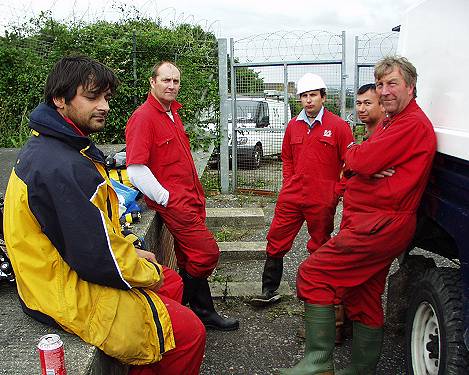
As the visit meant an extended period of time underground (over an
hour), MoD confined space measures had to be enforced which included
breathing apparatus training for myself and the use of a trained rescue
team to accompany me into the tunnels. These were a great bunch of guys
who took good care of me. They are from left to right:
Esteban Marrufo, Andy Collings, Joss Bond,
Stephen Coleman and Alan Fletcher. |
|
| |
| |
| |
 |
|
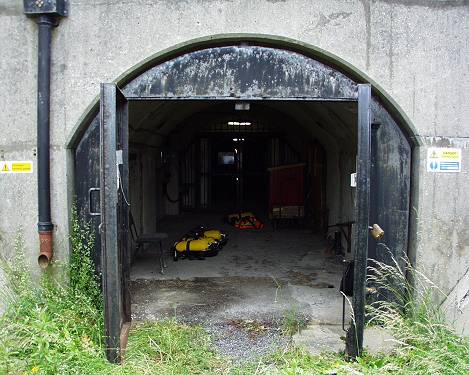
This is the entrance to the pipe (west) tunnel. The ventilation
fans have to be run up for at least 30 minutes before anyone can
enter. The BA kits are ready for the four man crew that has to
check the bunker out for hazards and air purity before anyone
else can enter.
|
|
| |
| |
| |
 |
|
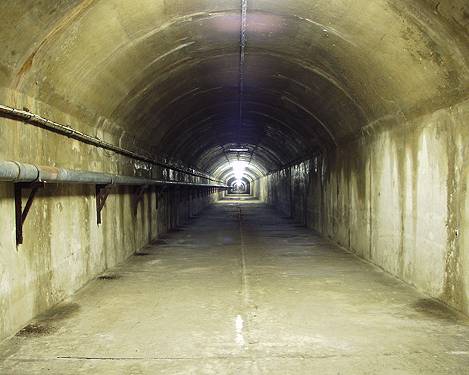
The pipe tunnel, so called because there are two 16 inch FFO pipes, one
10" diesel pipe and a sump pipe under the floor. The 4 inch pipe on the
tunnel wall is a dry riser used for fire fighting. This tunnel is 2150
feet long to the northern portal. |
|
| |
| |
| |
 |
|
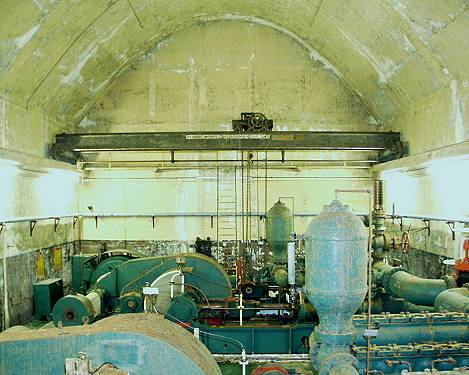
The pump room containing all the original machinery. These two electric
pumps operated at 350psi and could pump 400 tons of FFO per hour. |
|
| |
| |
| |
 |
|
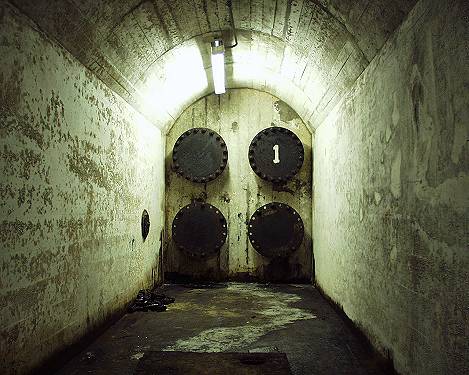
The end of fuel cell number 1 as seen from the access (east) tunnel.
This is the smallest of the fuel cells and is 200 feet long, 30 feet
wide and 40 feet high. It contained 5,000 tons of FFO. The big ones
(cells 4 to 9)
contained 17,500 tons each. |
|
|
|
|
Contributors |
|
Her Majesty's Naval Base
Portsmouth |
|
Commodore David Steel RN |
Portsmouth Naval Base Commander |
|
Lieutenant Commander Suzy
Conway RN |
Photographic Vetting |
|
Lieutenant Commander Tony
Ford RN |
Photographic Vetting |
|
|
|
Endeavour12 |
|
|
John Parsons |
Breathing Apparatus Training |
|
|
|
Defence Storage &
Distribution Agency - Frater
|
|
Richard Morgan |
Director |
|
Philippa Talbot |
General Manager |
|
Jane McDonald |
Security Officer |
|
Steve
Smith |
|
|
|
|
Defence Logistics
Organisation - Forton Oil Fuel Depot
|
|
Andy
Gaffney |
Officer In Charge (2007) |
|
Ged
Hallam |
Leading Stoker |
|
John
Abbatt |
Officer In Charge (2011) |
|
Brian
Smith |
Senior Store Keeper |
|
Steve
Parker |
Oil
Fuel Operative |
|
|
|
Fleet Support Limited
|
|
Ian
Booth |
Director |
|
Kev
Pearson |
Inspector of Works |
|
Andy
Collings |
Rescue Team Member |
|
Esteban Marrufo |
Rescue Team Member |
|
Stephen Coleman |
Rescue Team Member |
|
Alan
Fletcher |
Rescue Team Member |
|
Joss
Bond |
Surveyor |
|
Nigel
Hume (aka Mad Nige) |
Responsible Person |
|
|
|
Defence Aviation Repair
Agency Fleetlands |
|
Graham Sargent |
Director |
|
Brian
Davis |
SHE
Manager |
|
|
|
Others |
|
Adam
Shepherd |
Contributor |
|
Alex
Smith |
Contributor |
|
Andy
Salter |
Primary Contact at HMS Sultan |
|
Bernie Allack |
Naval Marine Engineering Practice |
|
Betty Callaway |
Contributor |
|
Brian Cave |
Contributor |
|
Clare Broomfield |
NMR Enquiry and Research
Services - English Heritage |
|
Dave Hessey |
Contributor |
|
Dave Stevens And His Dad |
1945 OS Map |
|
David Moore |
Palmerston Forts Society |
|
Fred Wall And His Dog |
Contributors |
|
Gary Smith |
Contributor |
|
G Bennett , Phil Cook, Andy Gaffney |
Additional Photography |
|
Ian Keefe |
Additional Research - Gosport Pipeline |
|
Jan West |
Camera Equipment |
|
Karen Priest |
Communications Manager -
Interserve |
|
Kevin Bedford And His Goats |
Charity Farm – Pit 15a |
|
Kevin Hurle |
Customer Service Centre, Ordnance Survey
|
|
Margaret Newman |
National Museum of the Royal Navy – HMNB
Portsmouth |
|
Mark Penfold |
Support, Encouragement & Time Off |
|
Mark Rutter |
Additional Photography |
|
Mel Sandford And Her Dog |
Additional Research - Gosport Pipeline |
|
Neil Russell |
Proof Reading, Calculation Checking and Tolerance |
|
Norman Beckett |
Contributor |
|
Peter Cobb |
National Archives Research |
|
Richard Gledhill |
Interserve |
|
Rod McConnell |
Secretary - Royal Navy Gunnery Instructors
Association |
|
Roy Bridger |
Contributor |
|
Stevie Hunt |
Specialised Graphics Work |
|
Stuart Jamie Graham |
HMS
Belfast Photos |
|
Tim Gardener |
Pilot For Aerial Photography |
|
Tony Triggs |
Contributor |
|
Warrant Officer John Adams RN |
Stokers Poem |
|
| |
| |
|
|
|

|