|
The Requirement
A series of government reports circulated in the early and mid 1950s
highlighted the fragility of Britain's existing telephone network as the
weakest element in her nuclear defence system. Both government defence
communications and communications between remote stations and operations’
centres on the newly developed ROTOR radar system depended upon this
network of vulnerable, pre-war landline cables. Most of these trunk cables
passed through the centres of large cities which would be likely targets
in a nuclear attack. To partially rectify this situation new diversionary
cables were laid to circumvent the target areas and new ‘bomb-proof’
semi-underground repeater stations were built at the nodes of this new
system.
These stations were known as ‘GPO Protected Repeater Stations’. The
purpose of any telephone repeater station is to boost the strength of the
electrical telephone signal to counteract the losses that have been
incurred in the wires through which the signal has travelled. These
‘protected’ stations were different to standard repeater stations in that
they were specifically designed to continue operating in the event of
nuclear war and were often referred to as ‘hardened stations’. They would
carry essential war related traffic so that defence, recuperation and
retaliation could be maintained.
Only eight of these stations were ever built and they came in two
varieties: PR1 and PR2. The only difference between them is that the PR1
equipment rooms are about 20 feet shorter than the PR2.
They were located at: |
- PR1 Lyndon Green - Birmingham
- PR1 Portsdown - Portsmouth
- PR1 Queslett - Birmingham
- PR1 Stockport - Manchester
- PR1 Swinton - Manchester
- PR1 Uddingston - Glasgow
- PR2 Rothwell Haigh - Leeds
- PR2 Warmley - Bristol
|
Station Protection
The term ‘protected’ or ‘hardened’ is open to some interpretation in this
instance. The stations were designed in 1951; one year before the first
nuclear fusion weapon (H-bomb) was tested and were thus intended to
withstand the more sedate fission weapon (A-bomb) of that era. For
instance the first A-bomb (1945) had a yield of 20 kilotons (thousands of
tons of TNT) whereas the first H-bomb (1952) yielded 10 megatons (millions
of tons of TNT). The station had a ground floor and a single underground
basement level. It was fitted internally with not too substantial blast
doors and had its own power and air filtration systems. When compared to
nuclear bunkers in the USA or USSR it can be seen that the word
‘protected’ has been used here in its lightest sense. This was fairly
typical for UK nuclear protection as a whole.
Another factor which needs to be taken into consideration is that early on
in the Cold War a limited nuclear conflict was considered to be a likely
possibility not least because there were only a restricted amount of
fission weapons available. Hence the amount of protection given to any
hardened structure need not be extreme. However, once the MAD (Mutually
Assured Destruction) scenario arrived due to the proliferation of high
yield thermonuclear weapons, hardening to any degree began to look
unconvincing. |
|
|
|
 |
|
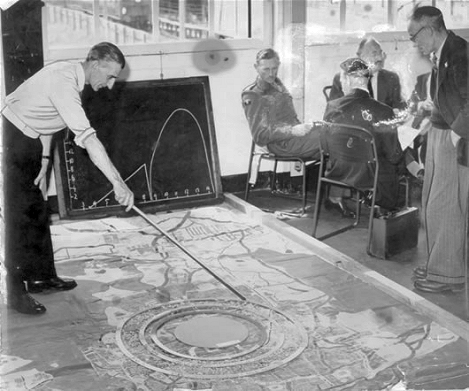
The map on the floor shows Portsmouth (Portsea Island) and the spread of a
nuclear detonation. The epicentre is at the junction of Lake Road and
Fratton Road; 1 mile east of Her Majesty's Naval Base Portsmouth. The
solid circle is 3/4 mile across and the outer ring 2 miles. The PR1
station at Portsdown is under the blackboard top right. |
|
|
|
The Layout
As has been stated the station consisted of a ground floor (above surface)
and a single level basement. The distribution of the equipment within
these floors does not appear to follow any logical design. For instance
the most vulnerable part of the building was the ground floor and yet this
contained equipment that was vital to the functioning of the station. The
building was divided into three distinct sections: 1) Office section 2)
Ground floor protected area 3) Basement protected area. The layout was
approximately as follows: |
|
Ground Floor
- Battery Room
- Main Distribution Frame (MDF)
- Repeater Racks (PRE/51)??
- Manual Telephone Switchboard
- Repair Area
- Valve Store
- Motor Generator Sets
- Air Intake, Filtering and Distribution
- Crane Shaft
- Emergency Exit with Chicane
|
Basement
- Diesel Generators
- Transformers
- Air Filtration Plant
- HV Electrical Switchgear with CO2 fire suppression
- Cable Glands – for the comms cables
- Repeater Racks (PRE/51)??
- Air Compressors
- Emergency Exit with Ladder to Surface
There was no provision for personnel accommodation such
as sleeping and shower facilities in the protected area.
Electrical Provision
Since the stations were built before the era of solid state electronics,
such as transistors and microchips, thermionic valves (usually referred to
as just ‘valves’) were used in the circuitry. These consumed a
considerable amount of power even when on standby and emitted a
significant amount of heat. Consequently a generous power plant was
required just to power-up and cool the electronics. Because the stations
had to operate under wartime conditions they were self sufficient in this
respect having two diesel powered 3-phase AC generators. One of these was
a 215 kVA unit supplying the DC power via motor generator sets and the
telecommunications load. The other 250 kVA unit served the environmental
requirements of the station such as air-conditioning and lighting. Given
the size of the station the versatility of the power distribution system
was quite sophisticated. Once power from the national grid was lost
emergency lead-acid batteries took over until one of the diesels
auto-started using compressed air from a pressure vessel. The underground
fuel tanks contained enough diesel to last four weeks. |
|
|
|
The End
The entire
interior of the Portsdown PR1 station was stripped out and sold for scrap
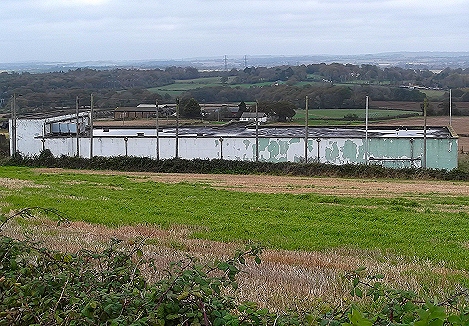
during March 2011. The empty shell is now
boarded-up.
UPDATE: 23/07/2019 - The
station has been utterly gutted and destroyed. (Source: Richard). |
|
|
|
| |
|
Grid
Ref SU663066 |
|
Google
Earth Aerial View
|
|
Visit
this site - Portsdown Walk No1
|
|
What
is a Repeater Station?
|
|
|
| Sources: |
Nick McCamley |
| |
Subbrit |
| |
Anon |
| |
Brian Wells |
| |
Jeff |
|
|
|
|